CalAPA Design
The CalAPA has been purposefully structured to address the state's Administrator Performance Assessment Design and Program Implementation Standards as well as key elements of the California Administrator Performance Expectations (CAPE). The CAPE are aligned with the California Professional Standards for Education Leaders (CPSEL). Adopted by the CTC in June 2016, the CAPE provide the conceptual and practical basis for the following three leadership cycles that comprise the CalAPA, with a focus on organizational development, change management, and leadership.
- Leadership Cycle 1: Analyzing Data to Inform School Improvement and Promote Equity
- Leadership Cycle 2: Facilitating Communities of Practice
- Leadership Cycle 3: Supporting Teacher Growth
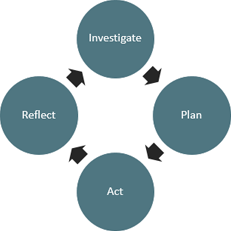
Each leadership cycle includes four inquiry-oriented steps: (1) investigate, (2) plan, (3) act, and (4) reflect. The Commission's CalAPA model provides an overarching conceptual framework of progressively interrelated cognitive steps to help guide and refine the administrative candidate's thinking and encourage decision-making throughout each cycle.
Acceptable evidence may be in a variety of forms, including video recordings and written narrative.
+− Leadership Cycle 1
Leadership Cycle 1 focuses on analyzing multiple sources of school data for the purpose of identifying equity gaps to inform an initial draft plan for equitable improvement in line with the school's vision, mission, and goals. Within the cycle of investigate, plan, act, and reflect, you will collect and analyze multiple sources of longitudinal quantitative and qualitative data. You will conduct an equity gap analysis to identify potential causal factors, all culminating in a problem statement defining a specific area of educational need related to equity. Based on your investigation and equity gap analysis, you will develop potential strategies for equitable school improvement, solicit feedback from key stakeholders, and explain how you will adapt your proposed strategies for equitable school improvement based on that feedback. At the conclusion of this leadership cycle, you will reflect on your capacity to identify potential causal factors and strategies to address equity gaps at the school, provide equity-driven leadership, and develop stakeholder support, as well as reflect on what strengths you would like to further develop.
+− Leadership Cycle 2
Leadership Cycle 2 focuses on facilitating collaborative professional learning within a community of practice for the purpose of improving teaching and student learning. Within the cycle of investigate, plan, act, and reflect, you will identify and work with a small group of educators to identify a problem of practice and select an approach for working together. Additionally, the group will identify an evidence-based strategy to address the problem of practice that will strengthen and increase equitable learning and/or well-being for all students. You will then facilitate meetings with the group and collaboratively lead the professional learning of the community of practice. In addition you will reflect on how your facilitation supports the group to address the problem of practice and how you responded to the group's feedback on your facilitation.
+− Leadership Cycle 3
Leadership Cycle 3 focuses on coaching an individual teacher to strengthen teaching practices and improve student learning and/or well-being. Within the cycle of investigate, plan, act, and reflect, you will familiarize yourself with coaching and observation practices at the school; identify a volunteer teacher whom you will coach; and conduct a full coaching cycle, including a pre-observation meeting, a focused classroom observation to collect CSTP-related evidence of practice, and a post-observation meeting. Throughout this leadership cycle, you will reflect on your strengths and areas for professional growth as a coach and an equity-minded leader.
Together, these leadership cycles and the related rubrics assess a range of the CAPE.

 View Cart